
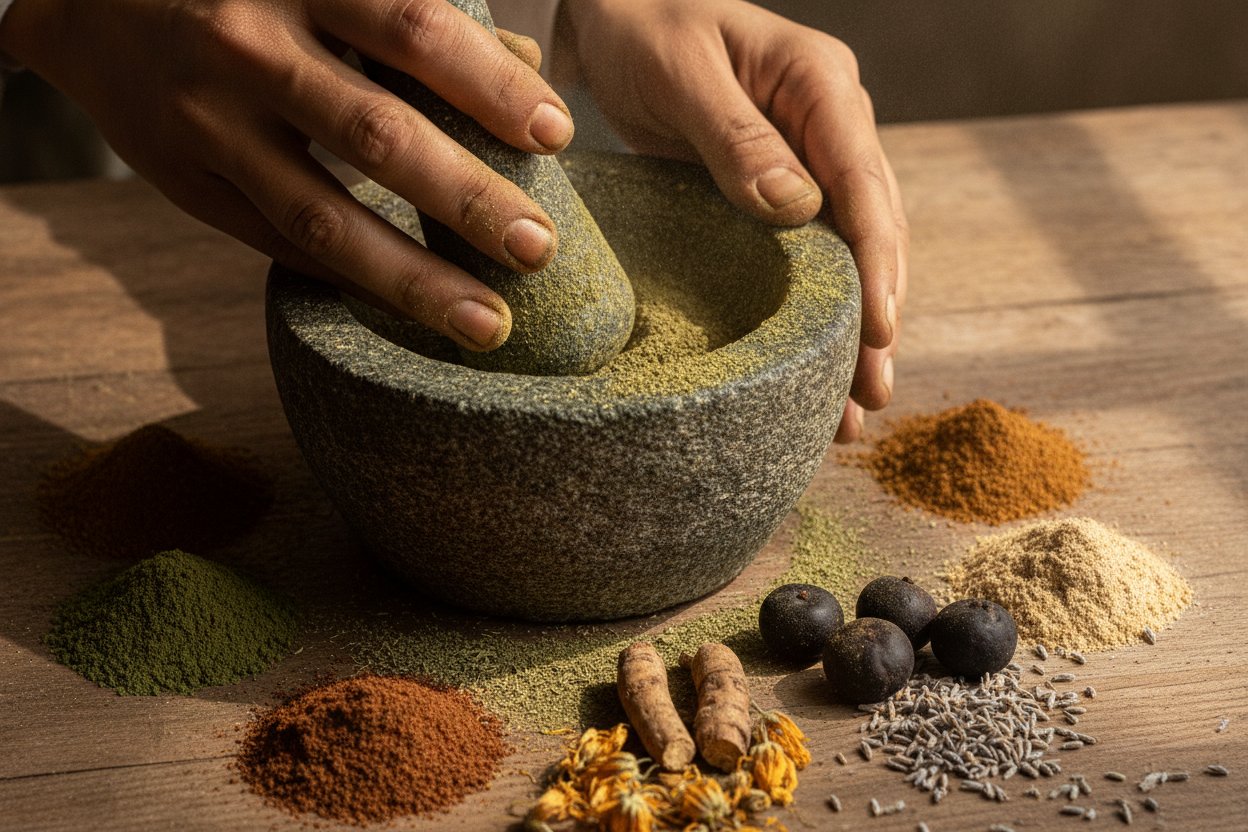
Know Your Dosha
All courses

Beginner course

Know Your Dosha

Understand your constitution and what pushes it out of balance

Vata, Pitta and Kapha describe how your body and mind are built. This course explains each dosha in plain language, helps you read your own Prakriti, and spot early signs of imbalance before they become illness.

Ideal before a consultation, or as a foundation for every other course.

You will learn

  • Identify your Prakriti (birth constitution)
  • Recognise Vikriti, your current imbalance
  • Know which foods, seasons and habits aggravate you
  • Simple first steps to rebalance each dosha

Sessions28 sessions · 21 h

  1. 1. Ayurveda: the science of lifeFree preview

    Origins, the classical texts and how Ayurveda looks at a person as a whole.

    45 min
  2. 2. The five elements (Panchamahabhutas)

    Space, air, fire, water and earth in nature and in the body.

    45 min
  3. 3. The twenty qualities (Gunas)

    Ten pairs of opposites, like heavy and light or hot and cold, that explain balance.

    45 min
  4. 4. The Tridosha theory

    How the elements form Vata, Pitta and Kapha, the three functional forces.

    45 min
  5. 5. Vata: qualities, seats and functions

    Dry, light, cold, rough, subtle and mobile; the colon as its main seat.

    45 min
  6. 6. The five types of Vata

    Prana, Udana, Samana, Apana and Vyana, and what each one controls.

    45 min
  7. 7. Pitta: qualities, seats and functions

    Hot, sharp, light, oily and liquid; the small intestine as its main seat.

    45 min
  8. 8. The five types of Pitta

    Pachaka, Ranjaka, Sadhaka, Alochaka and Bhrajaka.

    45 min
  9. 9. Kapha: qualities, seats and functions

    Heavy, slow, cool, oily, smooth and stable; the chest as its main seat.

    45 min
  10. 10. The five types of Kapha

    Kledaka, Avalambaka, Bodhaka, Tarpaka and Sleshaka.

    45 min
  11. 11. How your Prakriti is formed

    The constitution set at conception, and modern research in Ayurgenomics.

    45 min
  12. 12. Reading the body: physical traits

    Frame, skin, hair, appetite, sleep and energy for each dosha type.

    45 min
  13. 13. Reading the mind: Manasa Prakriti

    The three mental qualities Sattva, Rajas and Tamas, and mental traits of each dosha.

    45 min
  14. 14. Guided Prakriti self-assessment

    A structured questionnaire you complete during the session.

    45 min
  15. 15. Dual and balanced constitutions

    The seven Prakriti types and how to care for a two-dosha nature.

    45 min
  16. 16. Vikriti: your current state

    The difference between your nature and your present imbalance.

    45 min
  17. 17. The seven tissues (Sapta Dhatu)

    Rasa, Rakta, Mamsa, Meda, Asthi, Majja and Shukra, and how they are nourished.

    45 min
  18. 18. Wastes and channels (Malas and Srotas)

    Stool, urine and sweat, and the channel system that carries everything in the body.

    45 min
  19. 19. The four states of Agni

    Sama, Vishama, Tikshna and Manda: balanced, irregular, sharp and slow digestion.

    45 min
  20. 20. Ama: when digestion is incomplete

    How undigested residue forms, its signs, and gentle ways to clear it.

    45 min
  21. 21. Doshas and the seasons (Ritu)

    How each dosha builds up, flares and settles through the year.

    45 min
  22. 22. Doshas through the stages of life

    Kapha in childhood, Pitta in adulthood, Vata in later years.

    45 min
  23. 23. The six stages of imbalance (Shat Kriyakala)

    How Ayurveda describes illness developing, and why early care matters.

    45 min
  24. 24. Doshas through the lens of modern science

    Parallels with the nervous system, metabolism and the immune response.

    45 min
  25. 25. Eating for your dosha

    Tastes, foods and cooking methods that settle each dosha.

    45 min
  26. 26. Daily routine for your dosha

    Sleep, exercise, oils and work habits for each type.

    45 min
  27. 27. Emotions and the mind by dosha

    Recognising fear, anger and attachment as dosha patterns, and calming practices.

    45 min
  28. 28. Your personal dosha plan

    Bringing it all together into a written plan for food, routine and season.

    45 min

Quality assurance & herbal standardization

Uncompromising Purity: Standardized Formulations & Global Clinical Standards

Bridging 3,000-year-old classical Ayurvedic pharmacopeia with rigorous international safety, quality, and laboratory testing protocols.

years of classical pharmacopeia
3,000+years of classical pharmacopeia
years of clinical practice
33+years of clinical practice
batches with a COA
100%batches with a COA
01

Manufacturing

WHO-GMP Certified Manufacturing

Every herbal formulation is produced in Good Manufacturing Practice (GMP) compliant facilities adhering to World Health Organization guidelines for purity and batch consistency.

  • Batch-coded traceability
  • Validated processes
  • Classical preparation methods
02

Quality systems

ISO 9001:2015 & HACCP Quality Assurance

End-to-end quality management and hazard analysis protocols ensuring zero microbial contamination, strict hygiene, and international clinical safety.

  • Microbial limit testing
  • Hazard control points
  • Audited hygiene
03

Laboratory

Standardized Phytochemical Potency

Verified active marker compounds, heavy-metal free lab screening (ICP-MS tested), and pesticide-free wildcrafted & organic botanical sourcing.

  • Marker compound assay
  • ICP-MS heavy metals
  • Pesticide residue screen
04

Regulatory

Regulatory & Clinical Compliance

Formulated under licensed Ayurvedic medical supervision, compliant with international wellness regulations, and backed by transparent Certificate of Analysis (COA) documentation.

  • Physician supervised
  • COA for every batch
  • International compliance

Trust & accreditation

  • GMP Certified
  • 100% Organic Botanicals
  • Lab-Tested Heavy Metal Free
  • Cruelty-Free
  • ISO Certified
  • Physician Formulated

Have a batch number? Request its lab report.

Verify a Certificate of Analysis